Foundation outreach is rarely difficult because an organization lacks names. The harder part is turning those names into relationships.
A potential funder may begin as a row in a spreadsheet. Contact information may be stored somewhere else. Emails live in an inbox, meetings appear on a calendar, and follow-up notes end up in separate documents or remain in someone’s memory.
That approach may work when the list is small. As the number of prospective partners grows, basic questions become harder to answer. Have we contacted this foundation before? Did anyone respond? Is there an existing relationship we need to respect? What did we promise to send? When should we follow up?
At the Medulloblastoma Initiative, we realized that this was not simply an email problem. It was a relationship-management problem. We needed one connected system that could support the full process, from identifying a possible partner to managing the work that follows a meeting.
Turning a directory into a qualified pipeline
The program begins with a plain-language description of the organizations MBI wants to reach. We look for foundations that support pediatric cancer, childhood brain tumors, translational science, innovative therapies, clinical research, patient access, and closely related areas.
The system reviews foundation directories, grant databases, public records, partner pages, and medical-research funding lists. It then builds a structured profile for each potentially relevant organization. That profile can include funding priorities, geographic restrictions, typical recipients, previous grants, leadership, application procedures, and connections to pediatric oncology or medical research.
Just as important, the research identifies reasons a foundation may not be a fit. Some organizations do not accept outside inquiries. Others support only a specific hospital, region, or type of service. Some already have a relationship with MBI or someone in our network and should not receive a generic introduction.
The result is not a large list of names. It is a qualified pipeline with evidence behind each recommendation.
Using a scoring rubric to set priorities
Once the research was completed, the system created a scoring rubric to help determine who should receive attention first. The score drew from the evidence collected during qualification, including mission alignment, relevance to pediatric cancer or medical research, previous funding activity, known restrictions, the strength of the potential connection to MBI, and whether an appropriate contact could be verified.
The score did not make the decision for us. It gave us a consistent starting point. Without that structure, the largest or most recognizable foundations can receive all the attention even when another organization may be a better fit. Human judgment still mattered: a trusted introduction, a strategic connection, or new information could change the priority at any time.
Finding the right person
A strong organizational match is useful only if we can identify the right person to contact. The system searches for executive directors, presidents, program officers, research leaders, grants personnel, and trustees whose responsibilities suggest they may be appropriate recipients.
It also evaluates whether the available contact information is sufficiently supported. The system is not supposed to invent an email address or assume that a naming convention is correct. If a reliable recipient cannot be identified, the organization remains in the research pipeline until better information becomes available.
The selected contact and the reasoning behind that selection are preserved in the record. We do not have to reconstruct those decisions months later.
A controlled outreach schedule
Once a foundation was qualified, scored, and matched with a verified contact, it could enter the outreach queue. We did not release hundreds of emails at once. The system scheduled 25 targeted messages per day, beginning with the highest-priority prospects. That pace made it easier to monitor responses, address errors, and give each reply appropriate attention.
If a foundation did not respond to the introduction, the system scheduled a second message 10 days later. If the first two attempts received no response, a final follow-up was scheduled 15 days after the second message.
Before every send, the system checked for duplicate outreach, previous replies, existing relationships, suppression instructions, changed contact information, and earlier Gmail conversations. If a concern appeared, the message was held for review. Once a response was detected, the automated sequence stopped. The next action was based on what the person actually said, whether that was an invitation to meet, a request for information, a referral, a decline, or a request to reconnect later.
Connecting email, meetings, and follow-up
The most useful part of the program begins after someone responds. Replies are connected to the correct foundation record and Gmail conversation. When an answer requires more thought, an AI-assisted workflow can review the thread, the foundation’s history, requested materials, and unanswered questions. It then prepares a draft response for human review.
When a conversation leads to a meeting, the calendar event is connected to the same relationship record. The system can then prepare a daily briefing with the participants, their roles, the foundation’s priorities, the history of the relationship, potential questions, and the desired next step.
After the meeting, transcripts and notes can be reviewed for shared interests, concerns, promised materials, requested introductions, decisions, responsibilities, and dates. Those findings become tasks, waiting items, and reminders. If a foundation asks us to reconnect after a board meeting or during a future grant cycle, that timing is preserved. The relationship no longer depends on someone remembering a sentence from a conversation several months earlier.
One private view of the program
All of this information comes together in a private, login-protected foundation tracking website. From one place, MBI can review prospects, priority scores, outreach activity, follow-ups, responses, completed meetings, upcoming meetings, active conversations, declines, future reminders, and items requiring manual action.
The website can also generate an executive report on demand. Leadership can see what was sent, what happened afterward, which relationships progressed, and where attention is still needed without manually assembling information from email, calendars, transcripts, and spreadsheets.
The system also preserves institutional knowledge. If someone needs to understand MBI’s history with a foundation, the answer does not depend on finding the right email or locating the one person who remembers the conversation.
The early results
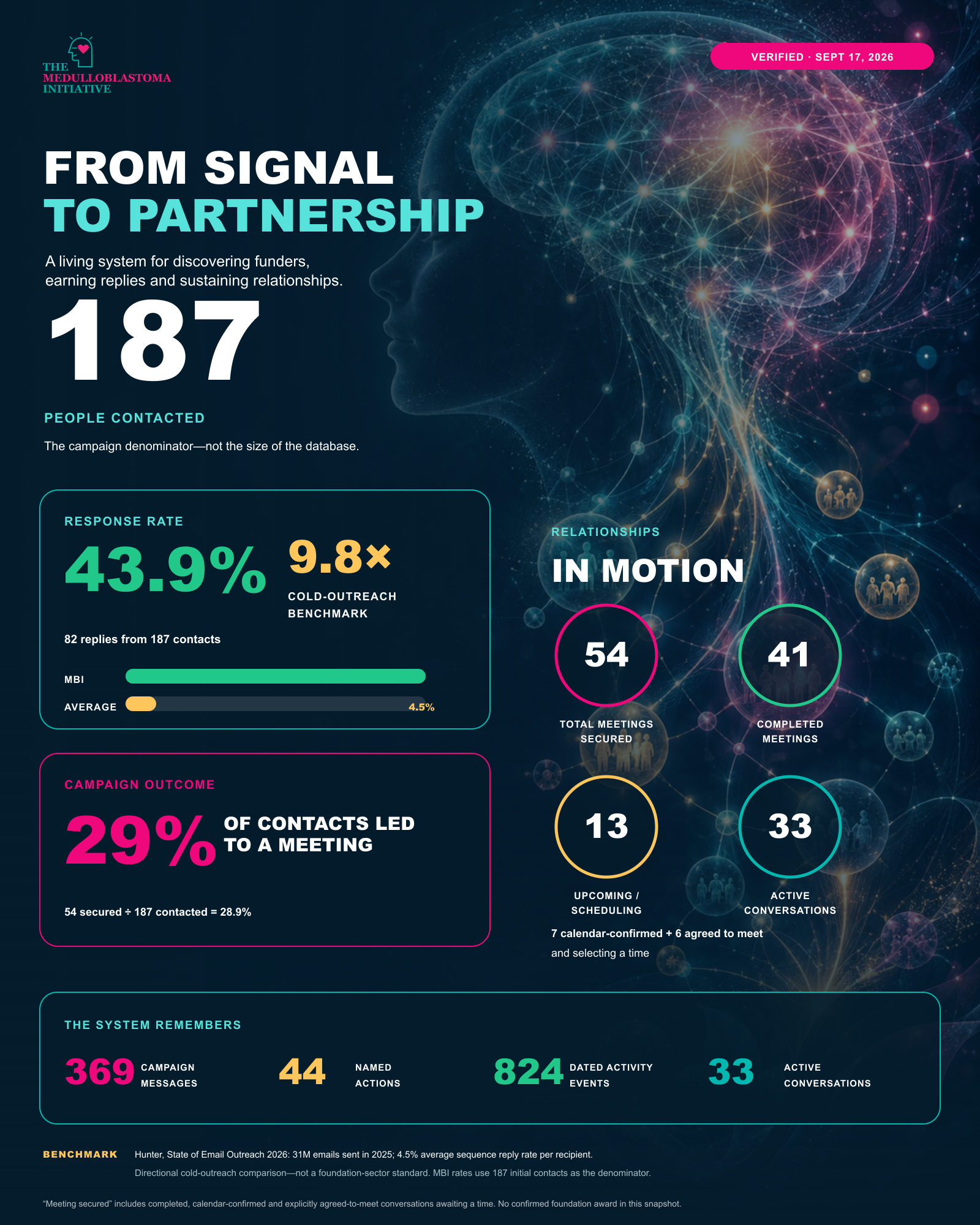
As of the September 16, 2026 production snapshot, the tracker contained 233 foundation contact records. MBI had contacted 167 foundations through cold outreach, and approximately 40 percent responded. Most significantly, 48 of those 167 cold outreaches resulted in a confirmed meeting. Forty-one meetings had already been completed, with seven more confirmed and upcoming.
That represents a 28.7 percent secured-meeting rate. Put more simply, almost three out of every 10 cold outreach efforts resulted in a confirmed meeting with MBI. Some respondents declined, while others remained engaged in email conversations that may still lead to an initial meeting. A clear decline is also useful because it allows us to close or defer an opportunity instead of continuing to spend time on a prospect that is not currently interested.
A note on the snapshots. The written case study uses the September 16 production snapshot. The infographic above is a verified September 17 update: 187 people contacted, 82 replies, 54 meetings secured, 41 completed meetings, 13 upcoming or scheduling, and 33 active conversations. Both snapshots describe relationship development, not confirmed foundation awards.
The tracker did not show a confirmed foundation award at that point. Meetings and active conversations demonstrate pipeline development, but they are not completed funding outcomes. The program’s early value is the qualified prospect base, the response rate, the confirmed meetings, and the structure for moving those relationships forward.
What AI does and what people still own
AI can help identify a potential funder, organize research, assign an initial score, locate a contact, prepare an email, monitor the follow-up schedule, detect a response, assemble a meeting briefing, and preserve the resulting actions.
It cannot decide what MBI should promise. It cannot determine whether two people trust each other. It cannot replace scientific credibility, personal judgment, or an honest conversation about shared purpose.
People still decide which organizations to approach, which messages are authorized, how sensitive responses should be handled, what commitments can be made, and which relationships deserve priority. The system handles coordination, consistency, and memory. That gives us more time for the work that requires a person.
One final disclosure
I was too busy doing the work described in this article to sit down and write the article itself. So I had AI help me with that too.
I supplied the facts, made the decisions, corrected the numbers, and shaped the point of view. AI helped organize the material and turn it into something people could read without taking me away from the work for several days.
In a small way, that is the best demonstration of the entire system. AI handled part of the workload so I could keep doing the parts that required me.